Department of

Bioengineering

Engineering innovative solutions to modern problems in medicine and biology


Bioengineering Research Areas

Penn State Bioengineering encompasses a diversity of research interests.  Below are the primary areas of research in the department with links to the faculty engaged in each area.

Artificial Organs

Our artificial organs program is centered around the artificial heart, left ventricular assist devices (VAD) and the pediatric ventricular assist device. Investigators in these areas study computational methods to determine blood flow in the heart and around valves, and use particle imaging velocimetry and modeling to continually improve VAD design. Major research laboratories are at University Park campus and at the Hershey Medical Center.

Faculty: Keefe Manning, William Weiss, Alan Snyder, Gerson Rosenberg

Biomaterials

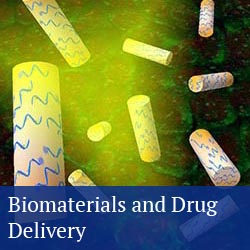
BiomaterialsBiomaterials is the science of the interaction of living cells and tissues with materials. At Penn State our biomaterials research focuses on cell material interactions, blood coagulation, and matrix effects on cells with interest in tissue engineering and improvement of artificial organ design.

Faculty: Christopher Siedlecki, Erwin Vogler, Alan Snyder, Henry Donahue, George Engelmayr

BioMEMS and Nanotechnology

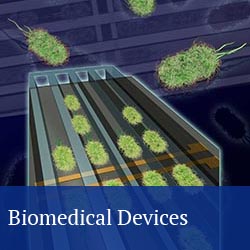
BiomaterialsBioMEMS and Nanotechnology are promised to revolutionize biotechnology and biomedical device industries, improve patient care, and reduce medical expenses in the 21st century.  Modern semiconductor fabrication technologies and novel micro/nano technologies are used to make devices under 100 micrometers in size.  Current main research focuses include lab-on-chip devices for in vitro diagnosis, implantable biomedical microdevices, nanoscale biosensors and actuators, microdevices and micro-PIV for cancer research and treatment, nanoparticles for bioimaging and drug delivery, molecular motor incorporated hybrid system, and microfabrication of biodegradable scaffolds for tissue engineering.

Faculty: Siyang Zheng, Tony Jun Huang, William Hancock, Cheng Dong, Peter Butler, George Engelmayr, Henry Donahue

Biophotonics and Imaging

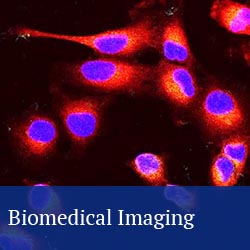
BiophotonicsBiophotonics is the use of laser light to probe molecular dynamics and interactions in model and physiological systems. Penn State Bioengineering houses advanced instrumentation for ultrafast laser spectroscopy, high-speed confocal imaging, optical traps, and total internal reflection fluorescence microscopy. Research applications are in mechanobiology of membranes and endothelial cells, cancer, molecular motors, and assessment of signal transduction pathways.

Faculty: Peter Butler, William Hancock

Cardiovascular Engineering

cardiovascularPenn State is a major strength in cardiovascular engineering with research ongoing into the molecular cellular, tissue, physiological and artificial organ levels of cardiovascular physiology and pathophysiology. Major research focuses are fluid dynamics in the heart, around valves, and in blood vessels, the hemodynamics origins of vascular disease, microvascular control of blood flow, and white cell cell-venule wall interaction in the microcirculation.

Faculty: Herbert Lipowsky, Peter Butler, George Engelmayr, Cheng Dong, Keefe Manning

Cell Signaling and Protein Dynamics

cell signalingCell signaling and protein dynamics focuses on intercellular and intracellular communications between proteins and cells at both cellular and molecular levels. Researchers integrate both in vitro and in vivo biological experiments with cell, protein and fluid transport dynamics in the areas of cancer metastasis, tumor microenvironment and extravasation, leukocyte adhesion, mechanobiology, energy metabolism, and system network biology. At the cellular level, investigators develop cell mechanics and biofluid transport models within the microcirculation. At the molecular level, we construct models in reaction kinetics, protein diffusion and convection, and signaling pathway network. Interdisciplinary collaborations extend bioengineering research within the College of Engineering to College of Medicine, College of Science, Huck Institutes for Life Sciences, and the Penn State Cancer Institute. For more information click here.

Faculty:  Herbert Lipowsky, Peter Butler, Cheng Dong

Mechanobiology

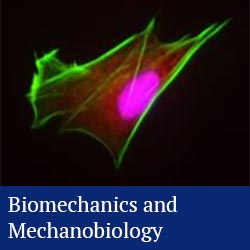
Mechanobiology Mechanobiology is the study of the interrelationship between force and cell biology. At Penn State, we explore this phenomenon at the molecular level by understanding the force effects on molecular motors, membranes, cytoskeleton, and receptor-ligand binding. At the cellular level we construct models of cell mechanics, and develop methods to assay changes in cell biology with application of force. At the tissue and organ level, investigators at Penn State explore properties of blood and force effects on blood vessels, bones, and physiological systems such as the heart and the microcirculation. For more information click here.

Faculty: William Hancock, Peter Butler, Cheng Dong, George Engelmayr, Keefe Manning, Herbert Lipowsky

Medical Imaging and Therapeutic Ultrasound

Our medical imaging team develops cutting edge applications for Ultrasound and MRI as well as optimization for imaging resolution and for small animal imaging. Facilities include the Penn State Center for Magnetic Resonance Imaging and the ultrasound transducer facility. Major research focuses are small animal imaging, functional MRI, drug delivery, therapeutic ultrasound, image processing, and others.

Faculty: Andrew Webb, Nadine Smith, Qing Yang, Christopher Collins


For more detailed information please navigate through the links below.

Research Laboratories

Hallowell Building

Artificial Heart (Manning)
Cellular Mechanobiology Laboratory (Butler)
Cellular Mechanics (Dong)
Magnetic Resonance Engineering Laboratory (Webb)
Microcirculation (Lipowsky)
MINIBio (Zheng)
Molecular Biomechanics (Hancock)
Therapeutic Ultrasound (N.Smith)
Tissue Engineering and Regenerative Medicine (Engelmayr)

Other University Park Locations

Biomaterials (Vogler)
Biomechanics Laboratory (Piazza, Sainburg, Sharkey)

Hershey Medical Center

Cardiovascular Biomaterials (Siedlecki)
Orthopedic Biomechanics (Donahue, You)
Center for Nuclear Magnetic Resonance Research (Collins, M.Smith, Yang)